Hello! Welcome back to my blog. I have been enjoying my Reading Week, as it has been a much needed break from classes which has allowed me to get a head start on some of my assignments as well as spend quality time with my family. Having this time also helps me put things in perspective. I find that my mind is often thinking about the future and my career goals, and as I am nearing the end of my undergraduate degree I am getting more and more excited to take the steps I need to fulfill them!
Recently, I stumbled upon a method of teaching reading called the Orton-Gillingham approach. Basically, this is a holistic way of teaching reading through the use of multisensory techniques implemented in a specific order based on the child's individual needs. More information can be accessed through their website: http://www.ortonacademy.org/approach.php Being an OG tutor is something that I am considering pursuing in the near future, as it really resonates with my values as an educator. Because of my interest in this subject, I recently reached out to a successful OG tutor based out of the States for some advice. Her blog can be accessed here: http://www.theliteracynest.com/ I look forward to hearing what she has to say, and I will continue to read her blogs to learn as much as I can about the OG methodology.
Here are a few reflections I wanted to include about my last blog. The StoryPatch App could be used as an added technological element to a lesson on parts of a story grammar. First, I could introduce the concepts of characters, setting, etc. to the class by reading a story aloud to them and having a class discussion to connect the story with its story grammar. My class would then complete a book study in which we would compare the elements of two different stories using a story grammar approach. The StoryPatch App could be used as a class to create a story using the help option, which would provide a structured introduction to how to write their own stories. Then, depending on the technology available, the children could write or type their own stories following the structure provided by the app but without assistance this time. This could be a fun way to incorporate learning as well as provide my students with a scaffolded approach to crafting their own stories.
To build on the concept of using a website to track students' ecological footprints, students could implement changes in their lifestyles to lower their footprints after viewing their results. They could present what they have learned to another class or to their school, and if possible they could use their knowledge to make changes in their own school in order to better help the environment. This could be connected to many different subjects, such as science, language, the arts, etc! It would be fun to leave it up to the class in a sense (similar to passion-based learning) to see what the students are interested in and what they produce.
Finally, I've been happy to see that some schools are giving their students computer time to play the math game Prodigy! I was able to talk to some students in a Grade 2/3 class who said they really enjoy playing the game, and a girl I tutor loves the game so much that I doubt she even realizes she is learning! I'm not sure how customizable the game is, but it would be cool if the teacher could set the questions to test a specific math unit that the children have been working on. I think that the teacher can build on what is presented in the game by monitoring what questions children are struggling with, and going back and reteaching/creating new lessons to solidify the concepts that may have been unclear.
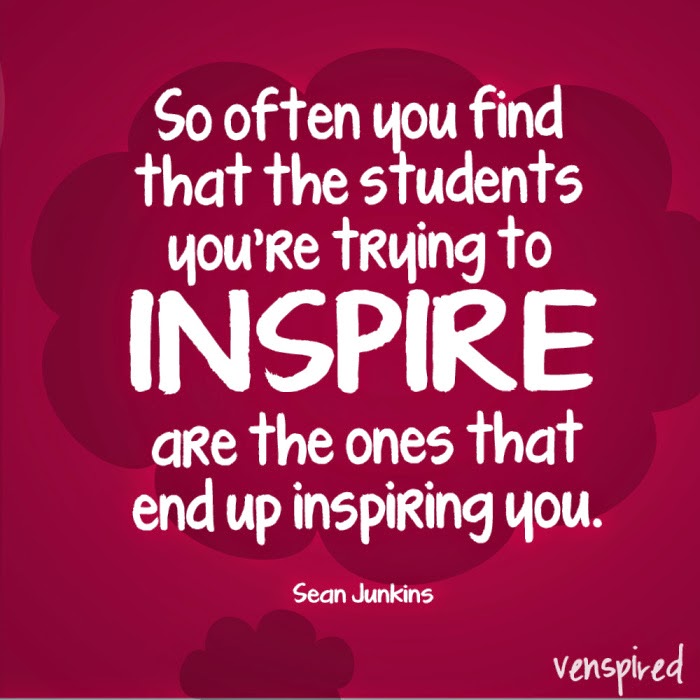
Thanks for reading my musings, and stay tuned for another reflection on what I am learning as a 21st century educator! (Image link: http://wbspectrum.com/4076/student-life/inspire-me/)
Saturday, 21 February 2015
Sunday, 25 January 2015
Reflections on My Personal Story So Far
Now that I am in my 4th
year of my undergraduate degree, I am really starting to realize where my
passions lie and what direction I’d like to go in after I achieve my teaching
degree. I have come to value the metacognitive process of reflection, as reflecting
allows me to recognize how my past experiences throughout my time at university
have shaped my future career decisions. Drake, Reid, and Kolohon (2014)
describe this as one’s personal story, which is situated within cultural,
global, and universal contexts. This blog will look at how my personal story is
constantly being reshaped based on my ongoing learning experiences within this
course and in my other classes.
One way that I am blending the
old story with the new story is by combining my drive to help children learn through
new ways of teaching with technology. I found this inspiring blog (which you
can access here:http://www.speechtechie.com/) where Sean Sweeney posts his knowledge about how to implement interactive
technology in the classroom to help your students with language-based
curricula.
One of his examples that I particularly
like is the StoryPatch App (http://storypatch.com/) which helps students to create a narrative by
illuminating the essential parts of a story (such as characters, setting, plot,
etc.). I enjoy that you can personalize instruction based on the level of
assistance the app provides for the child. For example, you can start by
building a story with help where students choose from a selection of choices.
As students increase their ability to write quality stories, they have the
option of creating a story without help, which allows them to have complete
control over the story writing process. Using an app helps bring the story to
life and could be a potential motivator for students who struggle with writing
or are uninterested in reading. Here is the YouTube video which describes how
the app works: https://www.youtube.com/watch?v=8fwQlp3dcp0
Drake et al. (2014) also describe how
educators have shifted their views from seeing assessment as an end product to
using assessment throughout the learning process as a way to continually adapt
instruction to meet student needs effectively. Ongoing assessment requires
teachers to constantly make observations and look at both the processes and the
products that children undergo or produce. This new way of thinking also aligns
with my belief in the constructivist philosophy, which involves students
drawing on their prior experiences to actively construct their understandings
of the world and to reflect on themselves as learners (Drake et al., 2014). Personally,
I am curious as to how I can connect the 21st century literacies
with the constructivist philosophy in the classroom. Right away, I see a
possible connection with environmental literacy by having students reflect on
the personal impact they have on the environment by tracking the ecological
footprint they are leaving on the world based on their daily choices. A cool
resource to use can be found here: https://islandwood.org/footprint-calculator/ As I engage with more course material, I will continue to reflect on concrete
ways that I can incorporate the different literacies into the classroom
experience. Hopefully, I will be able to put some of these ideas into practice
when I am engaged in teacher education placements next year.
Another avenue that has been
presented to me as a way to include 21st century teaching ideals in
my teaching bag of tricks is the use of video games in the classroom. A game
that I was recently introduced to, entitled Prodigy, is a math-based adventure
game that is based on the Ontario curriculum. You can access this game here:https://www.prodigygame.com/Play/ I
was amazed that I had not come across this game yet, and I am currently using
it with a girl in Grade 6 who I tutor in math. I love that the online game is free,
and that it adapts the questions to the student’s math skill level. Overall, I
am learning that even if a video game is not aligned with the curriculum, it
can still be used to teach 21st century skills such as critical
thinking, collaboration, and problem-solving.
Thanks for stopping by and
listening to my musings for this week! Stay tuned for future updates on how my
personal story continues to develop as I engage in new experiences.
-Michelle
Photo from: http://www.pinterest.com/pin/454652524857065154/
References
Drake, S. M., Reid, J. L., & Kolohon, W. (2014). Interweaving curriculum and classroom assessment: Engaging the 21st
century learner. Don Mills, ON: Oxford University Press.
Sunday, 18 January 2015
Exploring 21st Century Literacies
Hello! My name is Michelle Pottie, and I am studying to become an elementary school teacher. My specific passions are one-to-one tutoring and working with students who struggle with literacy. The purpose of this blog will be to explore multiple literacies and reflect on how I may use them in my future teaching career!
Thanks for stopping by,
Michelle
Photo retrieved from: http://commentsmeme.com/2014/03/14/so-often-you-find-that-the-students-youre-trying-inspire-are-the-ones-that-end-up-inspiring-you/
Thanks for stopping by,
Michelle
Photo retrieved from: http://commentsmeme.com/2014/03/14/so-often-you-find-that-the-students-youre-trying-inspire-are-the-ones-that-end-up-inspiring-you/
Subscribe to:
Posts (Atom)